
Seven minutes by design
Every module fits a strict envelope: one objective, an active learner moment at least every ninety seconds, and a hard stop. The format is specified, measured, and enforced at review gates, not eyeballed.
Trusted, traceable learning
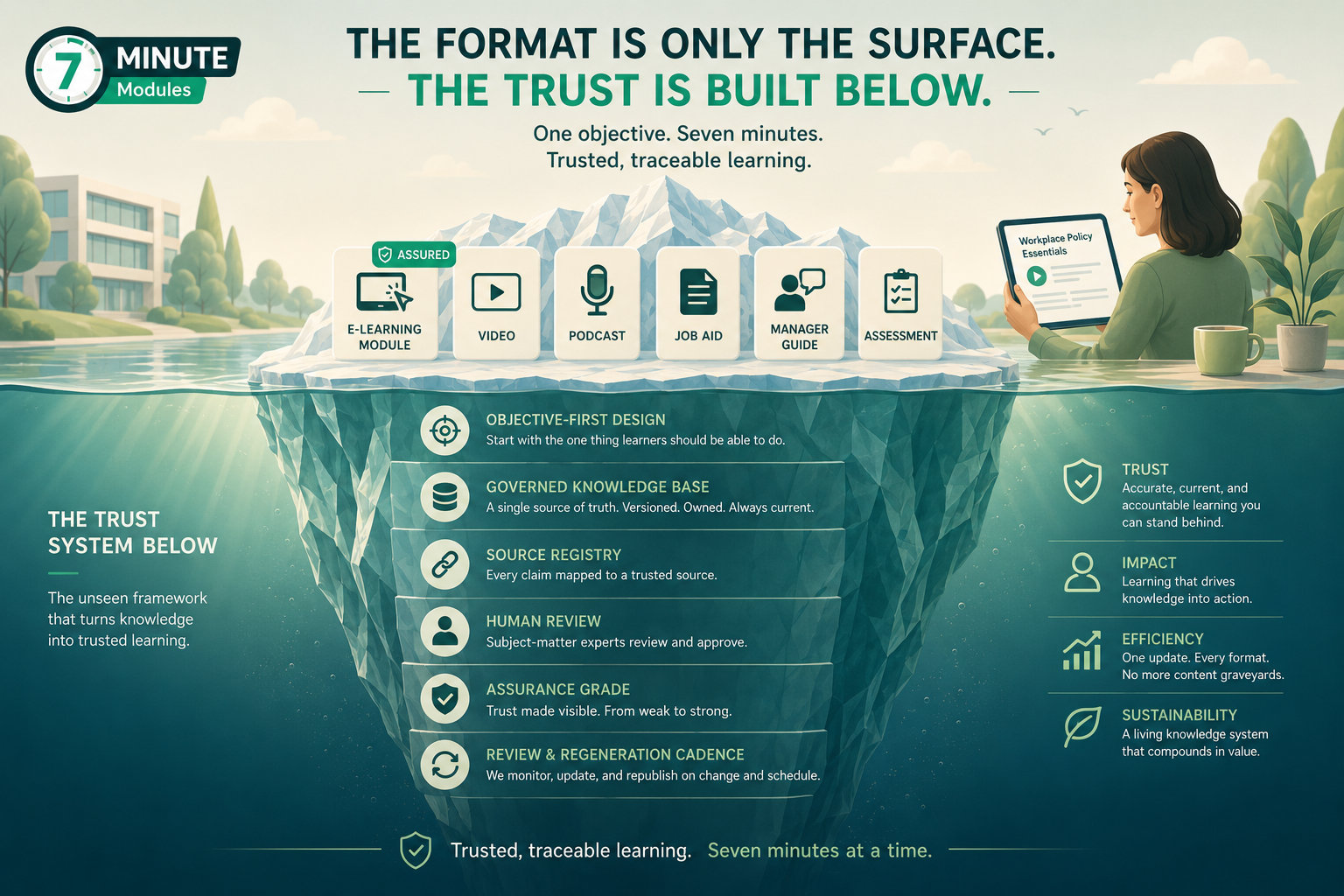
One behaviour per module. Seven minutes by design. Every claim traceable to a verified source, and every module carrying its own assurance status. Built for organisations where "trust us" is not good enough.
Any platform can produce a slick e-learning. What makes a module trustworthy is the framework underneath: where each claim comes from, who reviewed it, and how it stays current.
Not because attention is short, but because focus is precious. A module teaches exactly one decision routine, practises it, and stops.
Every module fits a strict envelope: one objective, an active learner moment at least every ninety seconds, and a hard stop. The format is specified, measured, and enforced at review gates, not eyeballed.
Each claim in a module links back to a registered, validated source. No orphan facts, no "common knowledge". If a source expires or changes, the module is flagged for regeneration.
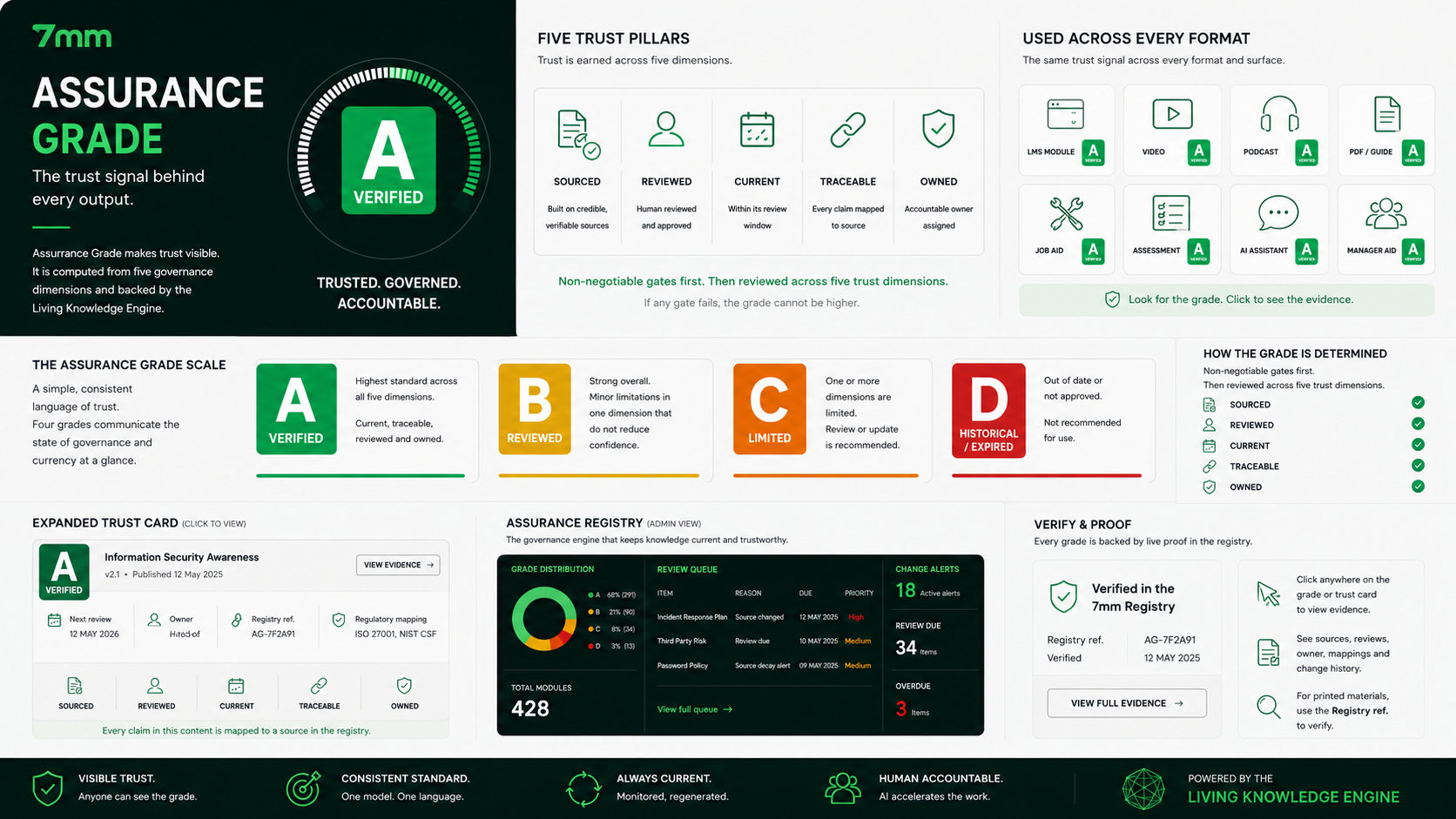
Modules carry a visible assurance grade backed by gate records: who reviewed what, when, and against which standard. The grade is computed from evidence, never self-declared.
The thinking behind the system, in three papers. Free to download, no registration required.
7MM-001 · Whitepaper
Why organisational learning has a trust problem, and how source registries, claim extraction, and assurance grades solve it.
Download PDF7MM-002 · Method paper
The format itself: the seven-minute envelope, the active-learner cadence, and the evidence base for designing modules this way.
Download PDF7MM-003 · System paper
How modules stay alive after publication: source revalidation, scheduled reviews, and regeneration instead of decay.
Download PDFThe first module does not stand alone. It is one governed output inside the AI-Safe Municipality journey. See the module, then look underneath it at the sources, claims, reviews and assurance records that make it trustworthy.
KB-AIDATA-001 · Journey: AI-Safe Municipality · Dutch
A decision routine for municipal staff: three checks before using an AI tool with personal data. Three scenario decisions, one retrieval moment, one if-then plan. Approximately seven minutes.
Status: concept G6.2, internal proof. Not published guidance and not client-configured; placeholders are intentionally unfilled.
The trust signal behind every output. A grade is computed from five trust pillars and backed by gate records; it degrades automatically when sources expire or reviews lapse.